

Specialized La Cornue Appliance Repair in San Francisco
Mon–Sat: 8:00 AM – 7:00 PM
You turn the knob, hear nothing, or hear clicks with no flame. This guide covers the common reasons a burner will not ignite and the checks that are safe for you.
Few things interrupt a kitchen like a burner that refuses to catch. The knob turns, perhaps the clicking begins, and nothing glows blue. Because a La Cornue cooktop is built from heavy, hand-assembled parts and often paired with brass or nickel trim, a failed light-up can feel like a bigger matter than it is. In most cases the burner needs a clean, dry seat or a replacement spark part.
A gas burner lights when three things come together: gas flows to the burner ports, a spark jumps close to those ports, and nothing blocks either. Take any one of these away and the burner will not light. That is why a burner that clicks without igniting and a burner that stays silent point in different directions. If the clicking is relentless, see La Cornue burner clicking constantly.
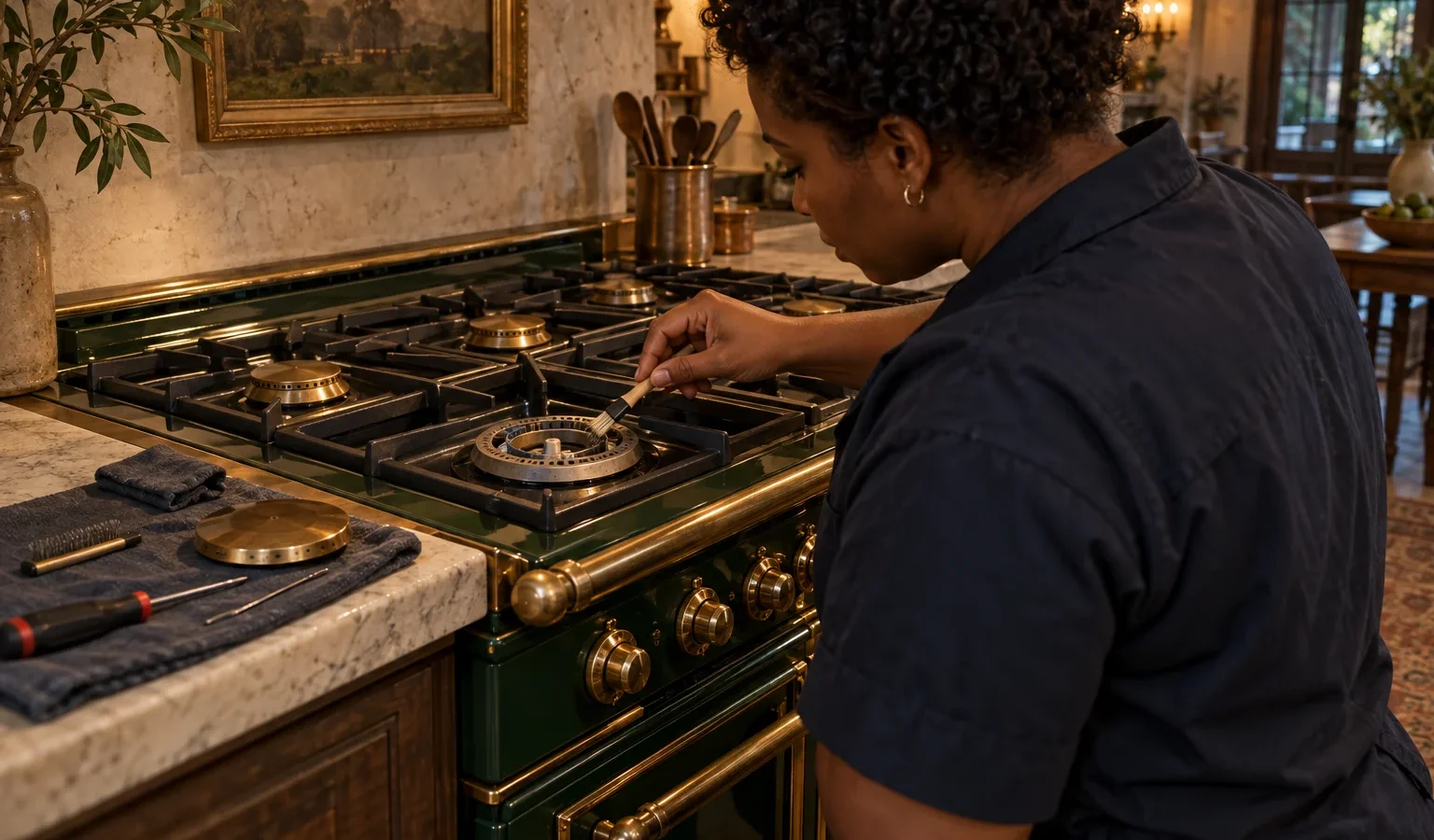
Most no-light faults start at the surface. Burner caps and heads must sit squarely, with their locating pins or notches seated. A cap that is tilted or the wrong way round steers gas away from the spark. Food, grease and cleaning residue can plug the small ports or coat the electrode tip, and moisture left after washing keeps gas and spark from meeting.
This is the most helpful clue. Gas reaches the range and the supply is fine, so the fault belongs to that burner: its electrode, its spark connection, its cap seating, its port blockage or its valve. A technician starts there instead of testing the whole range.
When no burner lights, widen the search. Is the range powered? Some models need electricity for ignition, so a tripped breaker leaves every burner dead. Is the gas shut-off valve open? Has there been recent work on the gas line, a utility interruption, or a move of the range? In older homes where lines were extended or regulators changed, a supply issue is a real possibility. If you smell gas, leave the room, avoid switches and the range, and call the gas utility or 911 from outside.
On the last point: wine-country homes on propane and city homes on natural gas have different needs, and a range that was converted incorrectly can be hard to light or burn poorly even if the parts are sound.
You may check that power is on, that the gas valve handle runs in line with the pipe, and that caps and heads are clean, dry and seated. You may do one controlled power reset at the breaker. You may not remove the cooktop top, handle gas fittings, test the module, or bypass a switch. Do not try to light a burner with a match unless your manual for that exact model describes it, there is no gas smell, and the other burners are off.
Most nuisance no-light faults begin with the way a cooktop is cleaned. Water poured over the burners to rinse off a spill runs into the ports and under the head, and it can sit there for hours. Strong sprays reach the electrode and leave a film that insulates the spark. A wipe with a damp cloth, followed by drying the parts and seating them correctly, keeps the ignition working for years. If your household uses a cleaner on the trim, keep it off the burner assemblies altogether.
Book a diagnosis if a clean, dry, correctly seated burner still will not light, if one burner is dead while the rest work, or if the problem returns after a short time. The technician checks the electrode, module, wiring, valve and gas supply, and gives a written estimate before anything is ordered. Nothing is repaired without your approval. Details are on our La Cornue rangetop repair page, and the La Cornue rangetops page outlines the lineup.
Have the full model and serial plate ready; it is usually under the front edge of the cooktop or behind a lower door. A Château 90 range and a Château 150 range do not share every part, and parts are brand-specific.
Spark is present, but gas is not reaching it or something is stopping the two from meeting. A misseated cap, blocked ports or moisture are the usual causes.
Yes. Water in the ports or on the electrode prevents a clean light. Dry everything fully and reseat the parts before trying again.
Only where the manual for your model describes it and there is no gas smell. Otherwise leave the ignition to a technician.
The supply and power are fine, so the problem is local to that burner: its electrode, spark connection, cap or ports.
Stop, turn off the knobs, leave the kitchen without touching switches, and call the gas utility or 911 from outside.
Share a few details and we’ll confirm an appointment. Prefer to talk? Call us and we’ll help right away.