Rangetops
Château cooktop modules in sizes from 29 1/2 to 70 7/8 inches. What the lineup includes, where the plate is, and what…

Specialized La Cornue Appliance Repair in San Francisco
Mon–Sat: 8:00 AM – 7:00 PM
For cooktop modules set into islands and counters: ignition, valves, flames and induction zones.
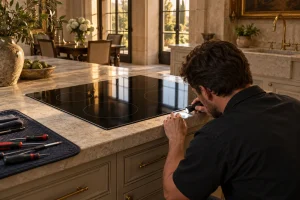
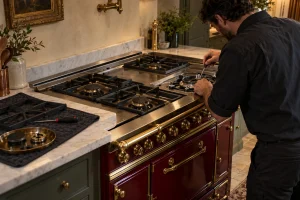
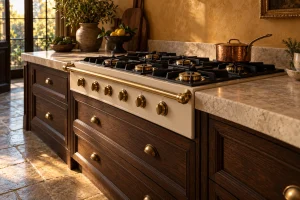
A La Cornue rangetop is the cooking surface on its own: a Château cooktop module set into a countertop or a custom island, with the burners and controls but no oven below. It is a different animal from a full range, because the gas and electrical connections run into the cabinet below, the controls often sit on the front or the side, and the ventilation above is a separate decision. Our La Cornue rangetop repair serves San Francisco and the Bay Area, and it covers diagnosis and repair of the burners, valves, ignition and induction modules.
Because there is no oven to confuse the picture, rangetop problems tend to be clear to describe. Most fit one of these patterns.
The technician starts with the part you can see and works down into the cabinet. Burners come apart first: caps, heads and the spark electrodes, checking for moisture, residue and wear. Then the controls, where a knob is turned slowly to see whether the valve behind it opens fully, and the ignition path, where we watch the spark and listen for a click that does not match the pattern. Gas supply is checked at the connection into the cabinet, because a rangetop built into an island can be fed through a long run of pipe that a range against a wall never needs.
For an induction module, the pan type and its placement come first, followed by the displayed message. We then look at the module’s power feed and cooling, because the electronics in an induction unit overheat when ventilation space below the cooktop is blocked by a drawer, a shelf or an appliance someone later tucked into the cabinet.
La Cornue documents five display messages on its induction cooktops and ranges. E reads as an electronic failure. E2 reads as an overheated electronic unit, and it can also follow a pan that boiled dry. Er followed by a number is an internal fault that an owner cannot clear. U shows when no pan is detected or the pan is not suitable for induction, and it goes away when a suitable pan sits on the zone. U400 means the cooker is connected incorrectly; the control switches off after about a second and the code stays on screen. Details are on the pages for code E, Er codes and code U400. We do not offer a reset sequence for any of them, because the right next step depends on what the diagnosis shows.
Nothing beyond this needs doing before a visit. Opening the cabinet to look at the gas fittings or the wiring is not a job for the owner.
You smell gas: leave at once, avoid switches, and call the gas utility or 911 from outside. You see sparks, smell burning or notice melted plastic around a knob: shut the power off at the breaker. A burner that ignites with a loud pop, or a flame that rolls out past the cap, should also stay off until it has been examined.
Rangetops come in the same widths as the full ranges, and a cooktop module is easy to confuse with the range of the same name. A Château 150 cooktop and a Château 150 range have different parts, so the plate on your unit decides what we bring. It is usually under the cooktop front edge or inside the cabinet below, and the guide to finding your La Cornue model number helps if you cannot see it.
We confirm the model and symptom, arrange an appointment, and diagnose on site. You receive a written estimate and nothing is repaired without your approval.
See the lineup on the La Cornue rangetops page, or go to the Château 120 cooktop and Château Grand Palais 180 cooktop pages. For burner symptoms, the articles on constant clicking and knobs and valves go further.
A rangetop has the burners or induction zones and no oven below, so the work stays on the surface, the valves, the ignition and the supply. A range repair adds the oven cavity and its controls.
Château cooktops listed in the lineup: the 75, 90, 120, 135 WD, 150, 165 and Grand Palais 180. If you have one that is not on that list, send the plate details and we will say what we can do.
Not necessarily. Moisture around the electrode or a cap that is slightly off-center keeps the spark running. Turn it off, dry the cap and head, seat them flat and try again once. If the clicking returns, book a diagnosis.
Often the diagnosis starts from above and from the cabinet below. If the unit has to be lifted out, we tell you before we do it and explain what we expect to find.
Leave the gas valve where it is and let the technician handle it. Closing it is a safe thing to do if you are worried, but nothing in the supply should be disturbed beyond that.
Château cooktop modules in sizes from 29 1/2 to 70 7/8 inches. What the lineup includes, where the plate is, and what…
Diagnosis and repair for La Cornue induction hobs and induction ranges in San Francisco and the Bay Area: zones that stay cold,…
Gas and electric oven cavity repair for La Cornue Château and CornuFé ranges: ignition, heat, thermostat, fan and door seal, across the…
La Cornue range hood repair in San Francisco and the Bay Area for Euclid, Marquee, Cascade, Loge and CornuFé hoods: fans, noise,…
Diagnosis and repair for Château and CornuFé ranges across San Francisco and the Bay Area, covering burners, ovens, controls and induction.
Share a few details and we’ll confirm an appointment. Prefer to talk? Call us and we’ll help right away.