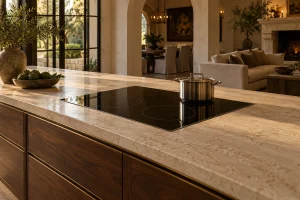
Induction Cooktops
Induction modules in Château and CornuFé ranges, with five verified display messages: E, E2, Er plus number, U and U400. What they…

Specialized La Cornue Appliance Repair in San Francisco
Mon–Sat: 8:00 AM – 7:00 PM
Cold zones, refused pans, sudden shutdowns and display messages on Château induction modules and CornuFé induction ranges, diagnosed at your home.
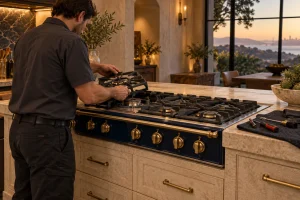
An induction module in a La Cornue kitchen is rarely a stand-alone appliance. It sits in a Château cooktop or in a CornuFé range, wrapped in custom cabinetry, fed by a dedicated circuit and watched over by a display that speaks in short codes. When a zone goes cold, a pan is refused or the whole surface shuts itself down, the cause can lie in the pan, the wiring behind the unit, the electronics, or the way the cooker was connected. Our induction cooktop repair in San Francisco and the Bay Area sorts out which, before any part is ordered.
Complaints fall into a few groups, and each points a technician toward a different part of the system.
Induction heats the pan itself through a coil beneath the glass, so a zone that stays cold may have a pan that does not respond to the field, a coil that has failed, a power stage that is not delivering, or a control that is not sending the command. Our post on an induction zone that is not heating walks through what to look at before booking.
The display shows a pan symbol or a letter, and the zone refuses to start. Pan detection compares what sits on the glass with what the unit expects. A small pan on a large zone or a warped base can cause it, and so can the detection circuit itself. The full explanation is in induction pan not detected.
A cooktop that cuts power mid-cooking is protecting something. Restricted cooling airflow, a pan that boiled dry or a weak supply can each trigger it. Read induction cooktop shuts off for the typical patterns.
The overview in induction error codes compares them. Five display messages are documented for La Cornue induction hobs, and each has its own page with the meaning and the owner checks that apply.
Diagnosis comes before repair. We begin with your description: which zone, what was cooking, what the display showed, and whether the problem began after a power cut, a remodel or a move of the range. The pans in use come next, because an unsuitable pan produces the same symptom as a failed part. After that the technician looks at the supply to the unit, the airflow around the electronics, the state of the glass and controls, and the message history you have noted.
You then receive a written estimate. Nothing is repaired until you approve it.
A great deal of induction trouble turns out to be an installation question, particularly in houses where the kitchen was rebuilt around the range.
These checks are all done from the outside, and none involves opening anything.
Turn the unit off at the breaker and leave it alone if you notice a burning smell, buzzing that is new, sparks, cracked glass, liquid that has run under the surface, or a code that returns the moment you switch on. A fault that keeps coming back should be examined rather than reset. If the cooktop is part of a range that also has gas burners and you smell gas, leave the house, avoid switches and call the gas utility or 911 from outside.
La Cornue builds in small numbers, and parts are specific to the brand and to the series. A Château induction hob module and a CornuFé induction range do not share the same display behaviour, and the codes listed above apply differently to each. The model and serial plate usually sits behind a lower door or drawer, or on the frame behind the oven door on a range, and under the front edge of a separate cooktop. If you cannot find it, read how to find the La Cornue model number.
Two induction-capable ranges appear in our lineup: the CornuFé 110, a 43 inch range offered as gas or induction, and the CornuFé 90, a 35.4 inch range offered as gas, dual fuel or induction.
You send us the model, the code and a short description through the contact form or by phone. We confirm the address and access, which matters on hillside streets and at gated estates. The technician examines the unit, tests it, and explains what was found in plain language. You receive a written estimate. If you approve it, the repair proceeds; if not, the cooktop is left as we found it.
The guide to La Cornue induction cooktops describes the lineup and the typical complaints for each. Owners of an induction range may also want CornuFé range problems.
U is an indicator that no pan is detected, or that the pan on the zone is unsuitable for induction. It clears when you set a suitable pan on the zone. If it persists with a known good pan centered on the zone, the detection side needs a technician.
E2 reports that the electronic unit is too hot. It can also appear if a pan has boiled dry. Switch the zone off, let the unit rest, and check that nothing blocks the airflow around it. If it returns with a normal pan and normal cooking, book a diagnosis.
No. An Er message followed by a number is an internal technical fault the owner cannot rectify. Write the full code down, switch off at the breaker if it persists, and request a visit.
U400 means the cooker is incorrectly connected. The control switches off after about a second and the code stays displayed. Because the cause lies in how the unit is supplied, it needs a technician and not a pan change.
Yes. We diagnose the Château induction hob module and CornuFé induction ranges. The plate with the model and serial numbers tells us which one you have, and which display messages apply.
Induction modules in Château and CornuFé ranges, with five verified display messages: E, E2, Er plus number, U and U400. What they…
Gas and electric oven cavity repair for La Cornue Château and CornuFé ranges: ignition, heat, thermostat, fan and door seal, across the…
La Cornue range hood repair in San Francisco and the Bay Area for Euclid, Marquee, Cascade, Loge and CornuFé hoods: fans, noise,…
Diagnosis and repair for Château and CornuFé ranges across San Francisco and the Bay Area, covering burners, ovens, controls and induction.
Burner, valve, ignition and induction repair for La Cornue Château cooktop modules in San Francisco, the Peninsula, Marin and wine country.
Share a few details and we’ll confirm an appointment. Prefer to talk? Call us and we’ll help right away.