Range Hoods
CornuFé hoods: Euclid, Marquee, Cascade, Loge and the CornuFé 90 and 110 hoods. Common fan, light and filter complaints and what to…

Specialized La Cornue Appliance Repair in San Francisco
Mon–Sat: 8:00 AM – 7:00 PM
Fans that will not start, blowers that rattle and hoods that no longer clear the air, looked at together with the duct run and power supply.
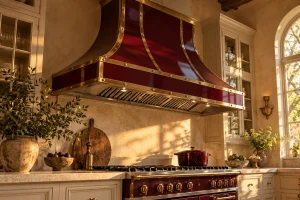
A La Cornue hood is part of the cooking system, not an accessory. It pulls steam, grease and heat away from a heavy French range, and it often defines the look of the wall behind it. When the blower stops, hums, rattles or moves less air than before, the range beneath it suffers too. Our La Cornue range hood repair in San Francisco and the Bay Area deals with the CornuFé hood family, from the Euclid, Marquee, Cascade and Loge to the CornuFé 90 and CornuFé 110 hoods.
A hood that is silent when you press the switch may have lost its power supply, have a control that no longer sends the command, a motor that has failed, or a capacitor or relay that no longer lets it start. If the lights work and the fan does not, the problem is narrower; if nothing works at all, the supply is the first suspect. Our post on a hood fan that is not working sets out the order of checks.
A blower wheel that has collected grease runs out of balance and rattles. Bearings wear, a loose mounting transmits vibration into the chimney, and filters clogged with kitchen grease cut airflow until the hood sounds like it is working harder and clearing less. A duct that has been crushed, disconnected or terminated badly has the same effect. The post on a noisy or weak hood explains how to tell these apart.
Lighting that flickers, goes out or fails to respond often comes down to the lamp, its holder, or the control rather than the blower. Filters that are not seated properly can rattle or let grease reach the fan. Read hood lights and filters for the common causes and what you can safely do about them.
We begin with what you have noticed. When did the fan last work normally, did the noise arrive suddenly or slowly, are the lights affected, and has anything changed in the kitchen, such as new cabinetry, a different range or a roofing job. At the hood, the technician looks at the filters, the visible wheel and housing, the controls and the supply. Then the duct run and the outlet are considered, because airflow depends on the whole path and not only the motor.
Diagnosis comes before repair. You receive a written estimate, and nothing is repaired until you approve it.
Hoods sit at the meeting point of electrical, ducting and cabinetry work, and many of the problems we see begin with the installation.
The CornuFé hood family is available in several designs. The Euclid, Marquee, Cascade and Loge hoods are offered in 36 inch and 44 inch widths. The CornuFé 90 Hood measures 35.4 inches, and the CornuFé 110 Hood measures 43.3 inches. Each page gives the model type and the usual complaints.
Everything below is done from the outside, with the hood switched off.
Do not remove the blower housing, test the wiring or reach into the chimney. Those jobs need a technician.
Switch off at the breaker and do not run the hood if you smell burning, see sparks, hear grinding or scraping, or find that the canopy or a filter has loosened. If the kitchen smells of gas, leave the house, do not touch any switch and call the gas utility or 911 from outside; a hood fan can pull the smell around, so leave the controls alone.
Hoods in this family differ in width and design, and parts are specific to the brand and the model. The plate with the model and serial numbers is usually behind the hood filters, so removing a filter is the quickest way to read it. If you need help, read how to find the La Cornue model number.
You tell us the model, the symptom and the address through the contact form or by phone. We discuss access, including stairs, narrow streets and gates, since hoods require a ladder or platform and a clear area under the canopy. The technician examines the hood, the controls and the visible duct and outlet, then explains what was found. A written estimate follows, and the work starts only after your approval.
The guide to La Cornue range hoods gives the lineup and the usual complaints. The hood works alongside your cooking surface, so you may also want La Cornue range repair and La Cornue rangetop repair when a gas range is involved.
The usual causes are grease on the blower wheel, worn bearings, a loose filter or fasteners that have loosened with time. A technician can tell which by listening and inspecting. Check the filters first, since a loose one is the simplest cause.
The supply is reaching the hood, so the problem sits in the fan circuit, the control or the motor itself. Do not open the hood. Note which speeds you tried and request a diagnosis.
It is usually behind the hood filters. Remove a filter carefully with the hood off and photograph the plate, including the model and serial numbers.
A restricted duct forces the blower to work against resistance and can shorten the life of the motor. Weak suction together with a straining sound is a good reason to have the whole duct run examined, not just the hood.
Yes. We service the CornuFé hood family, including the CornuFé 90 Hood and the CornuFé 110 Hood. Send the model and serial numbers so we can match the design.
CornuFé hoods: Euclid, Marquee, Cascade, Loge and the CornuFé 90 and 110 hoods. Common fan, light and filter complaints and what to…
Diagnosis and repair for La Cornue induction hobs and induction ranges in San Francisco and the Bay Area: zones that stay cold,…
Gas and electric oven cavity repair for La Cornue Château and CornuFé ranges: ignition, heat, thermostat, fan and door seal, across the…
Diagnosis and repair for Château and CornuFé ranges across San Francisco and the Bay Area, covering burners, ovens, controls and induction.
Burner, valve, ignition and induction repair for La Cornue Château cooktop modules in San Francisco, the Peninsula, Marin and wine country.
Share a few details and we’ll confirm an appointment. Prefer to talk? Call us and we’ll help right away.