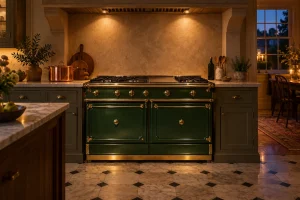
Ranges
Château and CornuFé ranges in gas, dual fuel and induction, from 75 to 180 in the Château line. See the lineup, where…

Specialized La Cornue Appliance Repair in San Francisco
Mon–Sat: 8:00 AM – 7:00 PM
Burners, oven, controls and ignition on Château and CornuFé ranges, diagnosed first and repaired only with your approval.
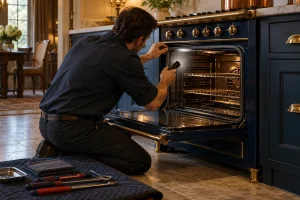
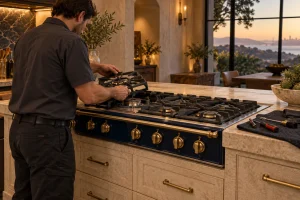
A La Cornue range is rarely just an appliance in a Bay Area house. It is usually the first thing a kitchen was designed around: a French range set into custom cabinetry in a Pacific Heights flat, between stone piers in a Napa Valley estate, or on a dedicated base in a Marin hillside remodel. When something stops working, the whole kitchen feels it. Our La Cornue range repair covers the full appliance, meaning the burners and the cooktop surface, the oven cavity or cavities, the controls and the ignition, in Château and CornuFé ranges across San Francisco, the Peninsula, the North Bay and the East Bay.
Complaints fall into a few groups, and sorting yours into the right one saves a lot of guessing.
We start with what you saw and when it began. Then the technician works outward from the symptom. For a burner that will not light, that means looking at the cap and head seating, the spark at the electrode, the flame safety part and the valve behind the knob, in that order, rather than replacing the igniter because it is the part everyone has heard of. For an oven, it means watching the cavity go through a full heating cycle and noting what it does and when.
The result is a plain explanation of what failed, what the repair involves and whether the part is a stock item or has to be sourced for your model. You get a written estimate before any repair starts, and nothing is repaired without your approval.
A heavy French range is sensitive to how it was installed, and many repair calls end up tracing back to the setting rather than the appliance.
If the fan is the issue, our La Cornue range hood repair page covers it separately.
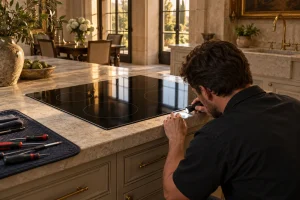
La Cornue induction displays use short messages, and five are documented: E, E2, Er followed by a number, U, and U400. A U means the display cannot find a pan, or the pan is not suitable for induction, and it clears once a suitable pan sits on the zone. E2 means the electronic unit has overheated, and it can also appear when a pan has boiled dry. Er followed by a number is an internal fault you cannot clear yourself. U400 means the cooker is connected incorrectly and shuts the control off almost at once while the code stays on screen. E is an electronic failure. See code E2 and induction error codes. If you see one, write it down exactly as it appears before you do anything else.
These checks take a few minutes and require no tools.
That is where owner checks stop. Do not remove panels, touch gas fittings, test circuits or bypass any switch.
If you smell gas, leave the house, do not touch light switches or the phone inside, and call the gas utility or 911 from outside. If you notice a burning smell, sparks or smoke, switch the range off at the breaker.
La Cornue ranges are built in small numbers and parts are specific to the brand, so a photo of the full model and serial plate speeds up everything. The plate is usually behind a lower door or drawer, on the frame behind the oven door, or under the cooktop front edge. Our guide to finding your La Cornue model number shows where to look.
You tell us the model, the symptom and the address. We confirm an appointment window, and the technician arrives with an idea of what to expect from your description. After diagnosis you receive the written estimate, and the work starts only once you approve it. We coordinate access with a house manager, designer or contractor when one is on site.
The La Cornue ranges page lists the lineup. If your range is a particular size, the pages for the Château 150 range, the CornuFé 90 and the CornuFé 110 have the specifics. For a symptom write-up, see burner will not light and dual fuel range issues.
Yes. We work on Château series ranges in the sizes La Cornue lists, from the 75 up to the Grand Palais 180, and on CornuFé 90 and CornuFé 110 ranges in gas, dual fuel and induction versions.
Switch the clicking off, lift the cap and head from that burner, dry them and set them back flat and centered. If it still fails, stop trying, because repeated sparking does not help and the cause is usually the spark path or the safety part, which needs a technician.
Yes. Diagnosis comes first, then a written estimate, and nothing is repaired until you approve it.
Parts are brand-specific, and the exact model and serial narrow down which igniter, valve or control your range uses. It avoids ordering the wrong part for a range that took years to arrive.
Château and CornuFé ranges in gas, dual fuel and induction, from 75 to 180 in the Château line. See the lineup, where…
Diagnosis and repair for La Cornue induction hobs and induction ranges in San Francisco and the Bay Area: zones that stay cold,…
Gas and electric oven cavity repair for La Cornue Château and CornuFé ranges: ignition, heat, thermostat, fan and door seal, across the…
La Cornue range hood repair in San Francisco and the Bay Area for Euclid, Marquee, Cascade, Loge and CornuFé hoods: fans, noise,…
Burner, valve, ignition and induction repair for La Cornue Château cooktop modules in San Francisco, the Peninsula, Marin and wine country.
Share a few details and we’ll confirm an appointment. Prefer to talk? Call us and we’ll help right away.