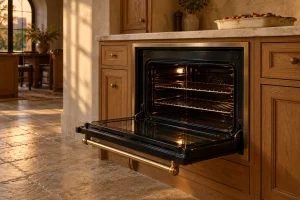
Ovens
The gas and electric oven cavities in Château and CornuFé ranges: complaints, where the plate sits and what to check before the…

Specialized La Cornue Appliance Repair in San Francisco
Mon–Sat: 8:00 AM – 7:00 PM
When the oven runs cold, bakes unevenly or will not light, we find the cause before any part is ordered.
A La Cornue oven does most of its work quietly, so the first sign of trouble is often a result: a roast that is pale on one side, a soufflé that fell, a kitchen that smells of something it should not. These are ovens built to be used for decades, and a failing part usually shows itself gradually. Our La Cornue oven repair covers the oven cavities of Château and CornuFé ranges in San Francisco and the Bay Area, gas and electric, from the igniter to the door gasket. The vaulted oven the brand is known for is something many of our customers ask about, and the approach to diagnosing it is the same as for any oven: find out what changed, then test it.
We ask what the oven did before it stopped behaving, then watch a full heating cycle. A gas cavity is observed from the first attempt to light, because the delay between the igniter glowing and the flame catching is the most telling moment. We check the igniter, the safety valve, the burner and its flame pattern, the thermostat and its sensing, and the door seal. In an oven with a convection fan, we also check the fan’s speed and whether it turns the right way. Anything that depends on a reading, we measure, rather than guess from the dial.
You then hear what we found in plain language and see a written estimate. Nothing is repaired without your approval, and if the cavity has an issue outside the appliance, such as the gas supply or the circuit feeding it, we tell you.
La Cornue builds ranges with gas ovens, with electric ovens in dual fuel versions, and with induction cooktops above electric ovens. The cavity beneath your cooktop is not always the same fuel as the cooktop itself, so the first fact we need is which one you have. A gas oven depends on safe, steady ignition; an electric oven depends on the element and its control. Troubleshooting one with the habits of the other wastes time. For ranges that mix both, our article on dual fuel range issues sorts out which side is likely to be the problem.
Do not open the back panel, reach into the burner compartment, touch gas connections or bypass the door switch. Those jobs need a technician and the right instruments.
If you smell gas, leave the house, avoid switches and call the gas utility or 911 from outside. If the oven gives off a burning smell, smoke or sparks, switch it off at the breaker and keep the door closed. An oven that lights with a loud pop or a visible flash should be turned off and left alone until it has been examined.
Oven parts are not shared across La Cornue ranges: the igniter, thermostat and gasket for a Château and a CornuFé are different. The plate is usually on the frame behind the oven door, or behind a lower door or drawer. Reading it before the visit is the quickest way to get the right part ordered. If you cannot find it, the model number guide shows the usual places.
We confirm the model, the fuel and the symptom, then set an appointment. The technician diagnoses on site, explains the finding, and you receive the written estimate before any work begins. Ovens in finished kitchens are heavy and hot, so we keep the work area clean and the cabinetry covered, and we work with your house manager or contractor if they are managing access.
The La Cornue ovens page describes the lineup. For symptoms, read oven not heating and uneven oven temperature. If you own a Château 120 range or a CornuFé 110, the model pages have more.
Yes. We service La Cornue oven cavities generally, and the vaulted oven is diagnosed the same way: ignition or element, safety parts, thermostat, door seal. We do not claim anything model-specific without your plate.
On a gas oven, a weak igniter or a slow safety valve is a common reason; on an electric one, an element or sensor may be failing. A technician needs to watch a heating cycle to tell which.
After a deep clean or a long idle spell, a mild odor can burn off during the first use. A smell that persists, smells like gas or comes with smoke is not normal, and you should follow the stop-using rules above.
You can look at the gasket and clean it, but fitting a new one without disturbing the door fit is easier with the right part and a technician. Send the plate details so the correct gasket is ordered.
Yes. Diagnosis comes first, you get a written estimate, and nothing is repaired without your approval.
The gas and electric oven cavities in Château and CornuFé ranges: complaints, where the plate sits and what to check before the…
Diagnosis and repair for La Cornue induction hobs and induction ranges in San Francisco and the Bay Area: zones that stay cold,…
La Cornue range hood repair in San Francisco and the Bay Area for Euclid, Marquee, Cascade, Loge and CornuFé hoods: fans, noise,…
Diagnosis and repair for Château and CornuFé ranges across San Francisco and the Bay Area, covering burners, ovens, controls and induction.
Burner, valve, ignition and induction repair for La Cornue Château cooktop modules in San Francisco, the Peninsula, Marin and wine country.
Share a few details and we’ll confirm an appointment. Prefer to talk? Call us and we’ll help right away.