

Specialized La Cornue Appliance Repair in San Francisco
Mon–Sat: 8:00 AM – 7:00 PM
Roasts brown on one side, pastry cooks faster at the back, or the oven runs hotter than the dial says. Here is how to tell what is behind it.
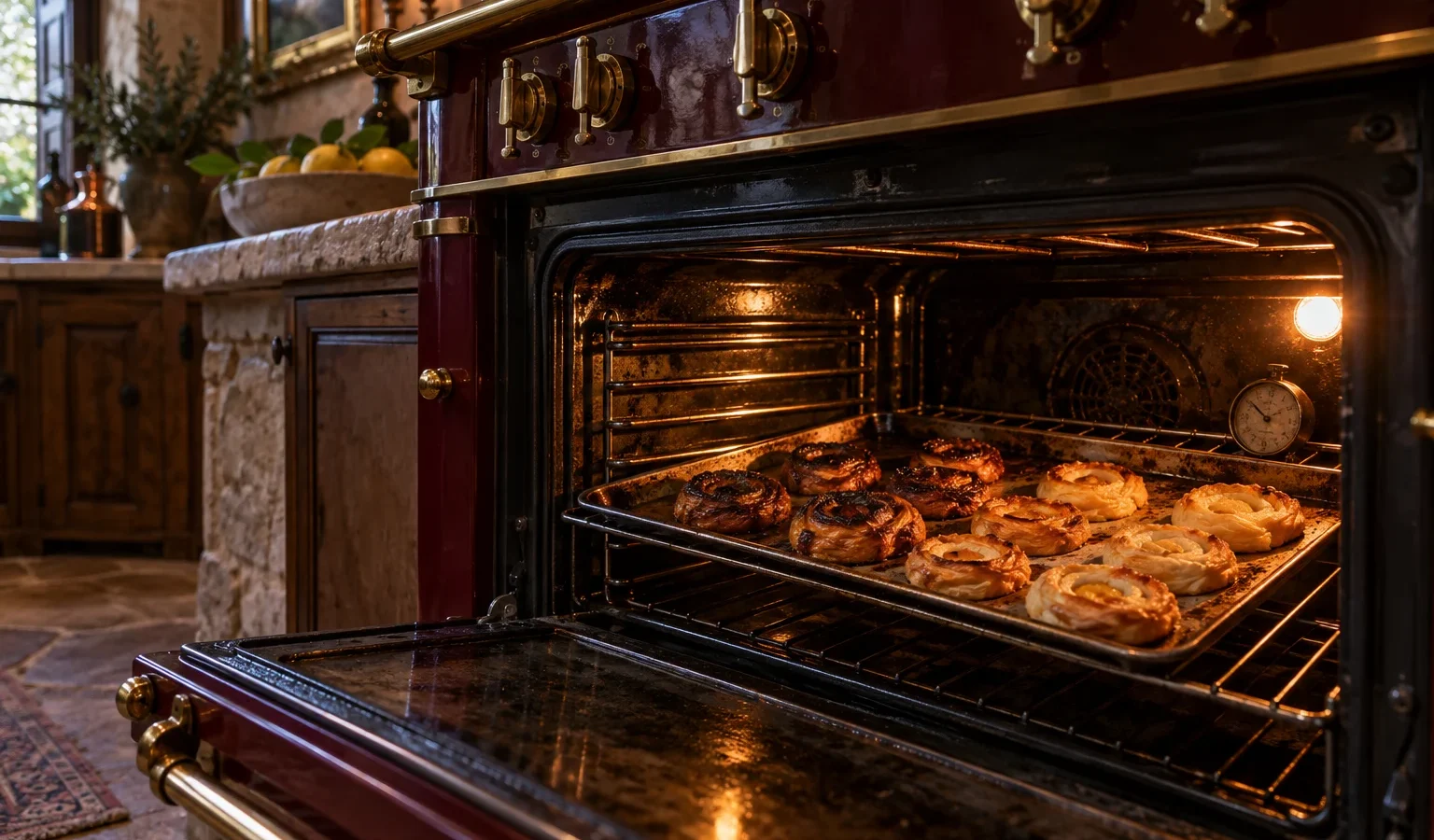
A baker notices the left tray finishing before the right, or a loaf that looks perfect on top and pale beneath. The dial says one thing, the food says another. In a La Cornue oven, uneven cooking is worth taking seriously because these cavities are built to hold steady, even heat, and a change usually points to a part that has drifted or a seal that has loosened.
People use the phrase uneven temperature for two quite different problems, and telling them apart saves time.
The first usually involves airflow, element or burner performance, or leakage. The second usually involves the temperature sensor, the thermostat or the control calibration. A technician treats them separately, and you can help by noting which one you see.
In a gas oven, heat rises from the burner and circulates through the cavity, shaped by the oven’s design and, where fitted, a convection fan. In an electric oven, elements at the top, bottom or rear cycle on and off as a sensor reports the cavity condition back to the control. When any of these links weaken, the pattern changes. A burner with partly blocked ports gives a lopsided flame. An element with a weak section heats in patches. A convection fan that runs slowly leaves still pockets of air.
The vaulted shape of a La Cornue oven also shapes how heat behaves, so owners who have used the oven for years often notice a drift quickly. Trust that instinct. If the oven used to bake evenly and no longer does, something has changed.
Keep it safe and external. Do not open panels or adjust anything behind the oven.
A single reading means little because every oven swings around its set point as it cycles. A consistent pattern over several uses is the useful evidence.
Do not compensate by raising the setting for months. Over time that stresses the enamel and can mask a failing sensor, and the true condition becomes harder to read. Do not scrub the oven interior with abrasive pads, as damaged enamel traps heat unevenly. And do not tape or block the door seal to cure a leak; it is better to leave the cause visible for a technician.
If rotating pans and clearing the cavity does not fix the pattern, or the oven is consistently far from its set point, book a diagnosis. The technician will check the sensor, the burner or elements, the fan, the seal and the control behavior, then give a written estimate before any repair begins. Nothing is repaired without your approval. Details are on the La Cornue oven repair page, and the lineup is described under La Cornue ovens.
Large units such as the Château 120 range and the Château 150 range do not share every part, and the CornuFé family, including the CornuFé 110, has its own components, so keep the full model and serial plate handy. It is usually behind a lower door or drawer, or on the frame behind the oven door.
Gas pressure in hillside homes can be less steady than in a flat city block, and propane supply in wine-country estates behaves differently from natural gas. A range that was moved during a remodel may also sit slightly off level, and a heavy range that is off level changes how heat and food sit in the cavity. Mention any of these when you book.
Every oven cycles around its setting, so small swings are normal. A repeatable pattern, such as one side always cooking faster, is not, and deserves a diagnosis.
Yes. A gasket that has flattened or torn lets heat escape along one edge, which cools that side of the cavity and can also make the oven work harder.
No. Calibration on these ovens belongs with a technician who can also check the sensor and control, since a mis-set offset can hide a failing part.
Where a fan is fitted, it evens out the air and the heat. If it slows or stops, you may notice cooler pockets even though the burner works.
Tell us which rack, which side, how often it happens, what an oven thermometer shows, and the model and serial plate details.
Share a few details and we’ll confirm an appointment. Prefer to talk? Call us and we’ll help right away.