

Specialized La Cornue Appliance Repair in San Francisco
Mon–Sat: 8:00 AM – 7:00 PM
A La Cornue range hood that rattles, whistles or barely pulls smoke has a short list of likely causes. Learn what the sound means and which checks you can safely make first.
When a hood above a La Cornue range turns loud or loses its pull, the cause is nearly always mechanical, and the sound itself narrows it. A high whistle tells a different story from a low rumble, and a rattle that changes with speed is not the same as a constant grind. Weak pull and noise often appear together because both come from air struggling to get through the hood.
Suction depends on air getting from the cooking surface, through the filters, past the blower and out through the duct. Anything that narrows that path weakens it. Greasy filters are the first and most common restriction. A duct that was fitted with extra bends, a flattened section, or an exhaust cap clogged with debris or a nest is the second. A damper that does not open fully is the third. Behind these sit the blower itself: a worn motor, a wheel coated in grease, or a loose wheel slipping on its shaft will all move less air than a healthy one.
Make-up air matters too. In tightly built or remodelled Bay Area houses, a powerful hood can pull against a sealed room. The air has nowhere to come from, so the fan labours, the sound rises and the pull falls. Opening a window slightly while the hood runs is a simple way to test whether that is happening.
The post on hood lights and filters goes into the care side of cleaning in more detail.
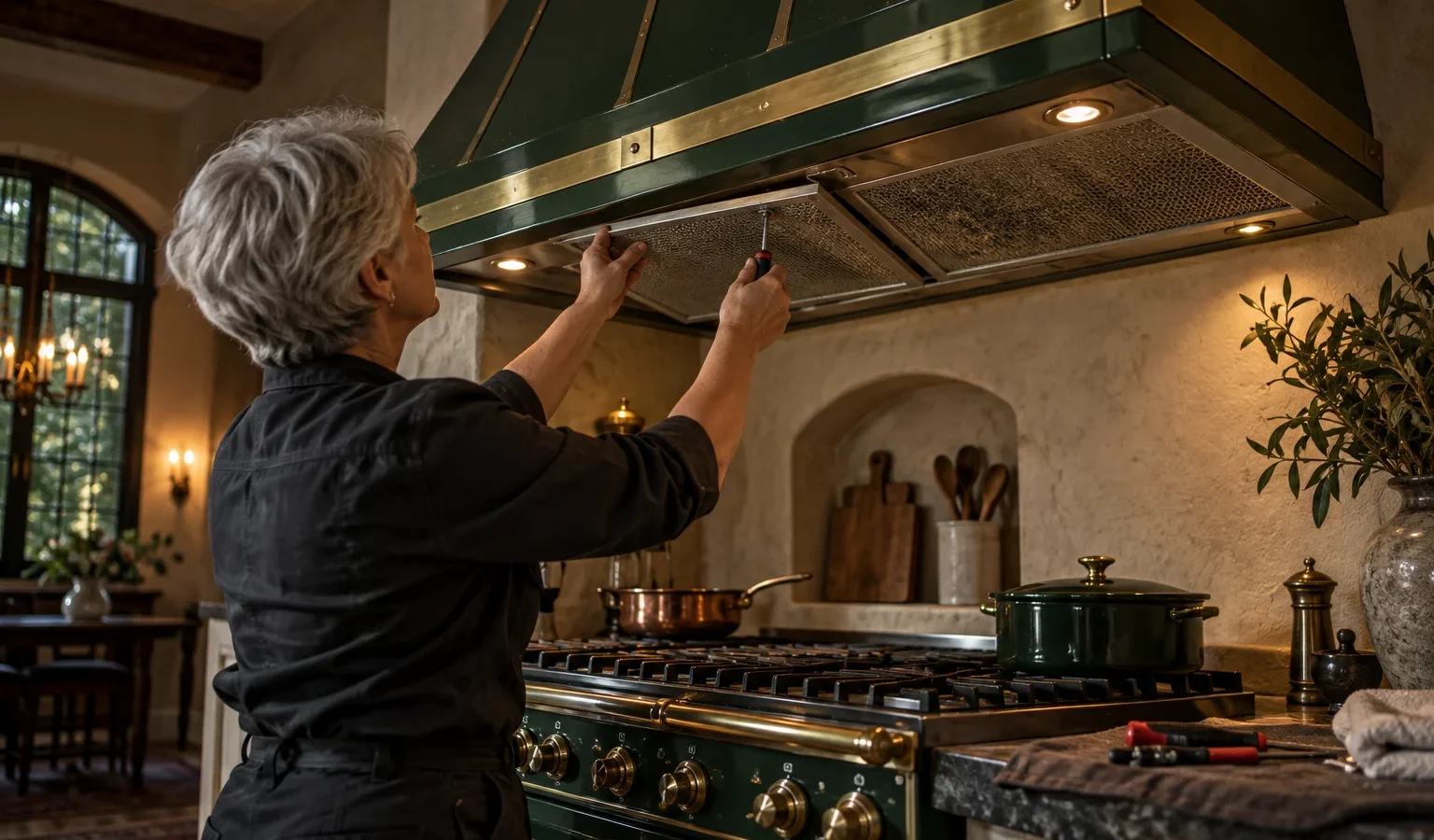
Do not remove the internal liner, reach into the blower housing, spin the wheel by hand or lubricate the motor. Do not tape over a rattling part with duct tape; tape traps heat and leaves residue on metal finishes. Do not run a hood that grinds or squeals, and never run one that smells of burning. If the noise began right after a filter was refitted, remove it and reseat it rather than forcing it into place.
La Cornue hoods are often fitted as part of a custom kitchen, with long runs of ductwork hidden in cabinetry, ceiling voids or an outside wall. The hood and range are chosen as a pair, and the duct run, number of bends and the exterior cap all affect how the hood performs. Hillside homes may have long vertical runs, and wine-country estates sometimes route ducts through roof structures. A technician looks at the blower, the damper and, where it is accessible, how the duct connects, and tells you plainly if the cause is outside the hood itself.
The CornuFé hood lineup includes the Euclid, Marquee, Cascade, Loge and the CornuFé 90 and 110 hoods. Parts are brand-specific, so the exact name and the model and serial plate matter. The plate is usually behind the filters. If you cannot find it, see how to find your La Cornue model number.
Book if the noise persists after cleaning and reseating the filters, if there is grinding or squealing, if suction has dropped even with clean filters, or if the hood shakes. A visit begins with diagnosis. You receive a written estimate and nothing is repaired without your approval. See La Cornue range hood repair for the process, and the range hood overview for the hoods we service. If the fan will not start at all, read hood fan not working instead.
You do not need technical words. Record a short video on your phone with the hood running at each speed, and note whether the sound changes when you open a window, turn on a second fan or close the kitchen door. A recording of the noise, a note on which speed is worst and a sentence about when it started tell a technician more than a long explanation. Mention any recent duct, roof or exterior work, since a disturbed duct or a new cap can change how a hood sounds overnight.
The common causes are clogged or loose filters, a restriction in the duct or damper, a loose panel that vibrates, or a blower wheel that has become unbalanced by grease.
Not necessarily. Greasy filters, a restricted duct, a stuck damper and a lack of make-up air all reduce pull while the motor is healthy. Checking filters and opening a window are good first tests.
No. Do not lubricate or open the motor. A grinding or squealing sound means a technician should look at it.
A light rattle from a loose trim is not dangerous, but a grinding noise or burning smell is. Stop using the hood and switch it off at the breaker in those cases.
It is usually behind the filters. Switch the hood off, remove a filter and look at the interior frame.
Share a few details and we’ll confirm an appointment. Prefer to talk? Call us and we’ll help right away.