

Specialized La Cornue Appliance Repair in San Francisco
Mon–Sat: 8:00 AM – 7:00 PM
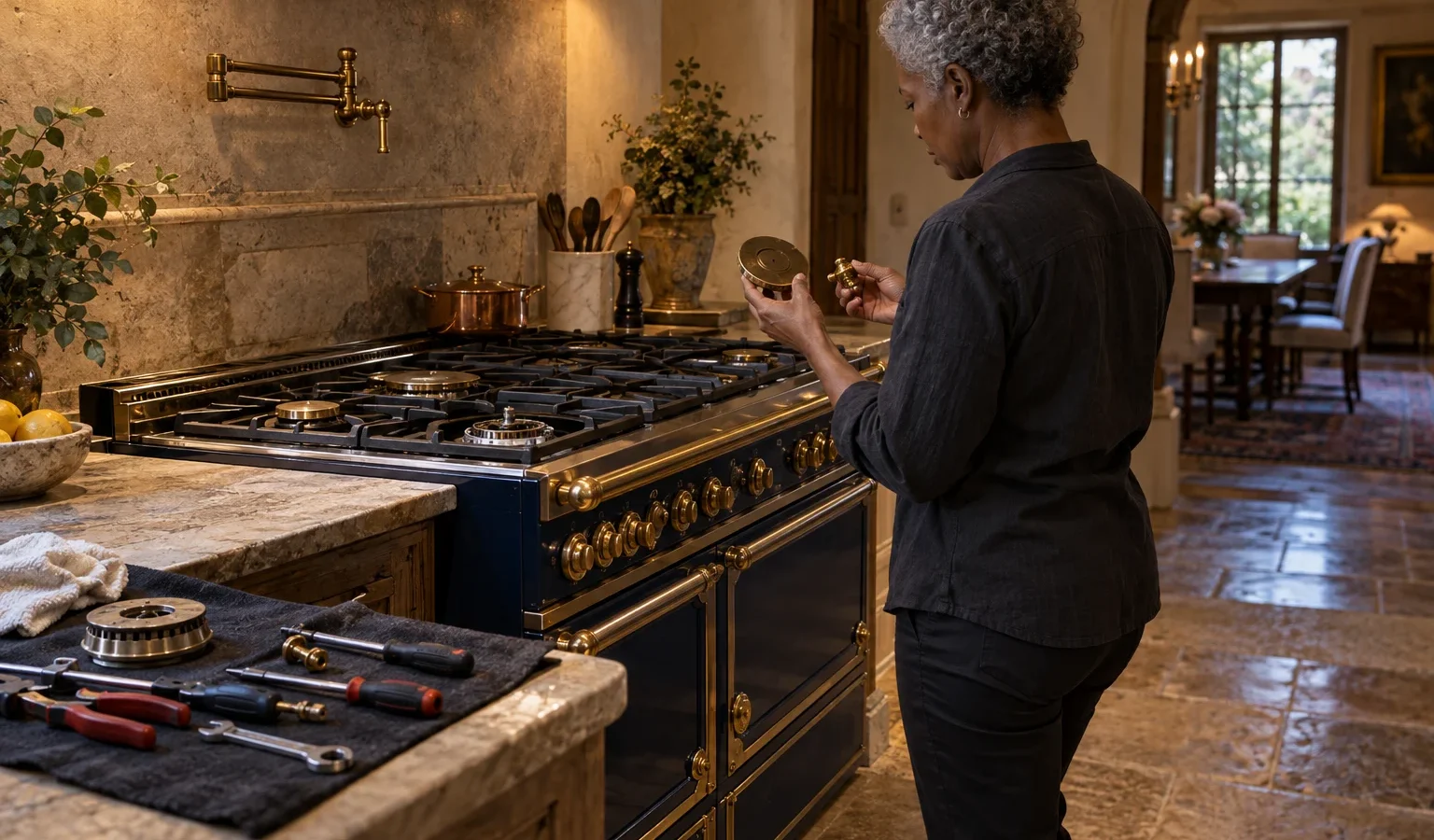
When a La Cornue range starts to fail, the decision to repair or replace is rarely only about the fault. Here are the factors that matter and how a diagnosis helps you choose.
A La Cornue range is rarely a casual purchase. It often anchors a custom kitchen, sits on a purpose-built base or between cabinetry, and is connected to a dedicated gas line, an electrical supply and a matching hood. That is why a failure prompts a bigger question than usual: is it worth fixing, or is this the moment to change course? There is no formula that holds for every home, but a handful of factors reliably shape the answer.
You cannot weigh repair against replacement without knowing what is wrong. A burner that will not light, an oven that runs unevenly, an induction zone that stays cold and a hood that rattles each have different causes and different repairs, and some are small. A diagnosis also checks the things around the fault: supply, ventilation, level and the condition of the oven door and trim. It turns a vague worry into a defined job. Request one before making any decision, and ask for the findings in writing.
Changing a heavy range involves more than a delivery. Bay Area homes often have retrofitted gas lines, hillside access that complicates moving heavy equipment, and cabinetry cut to specific dimensions. Gas to propane conversion, the regulator, the dedicated circuit for dual fuel or induction, the floor level and the hood duct all become part of the job. A range of a different width can leave gaps or require new work in the surrounding cabinetry. Repairing the existing unit avoids all of that, and replacing it deserves proper planning.
The range families we service include the Château series in several widths, such as the Château 120 and Château 150, and the CornuFé family, including the CornuFé 90 and CornuFé 110. Each has a model page with the relevant details.
A diagnosis tells you what is wrong, what a repair would involve and whether parts can be matched. It cannot tell you what you want your kitchen to be. We give findings and a written estimate, and nothing is repaired without your approval. If the answer is to repair, we proceed once you agree. If the answer is to replace, you will at least know why. Read more about La Cornue range repair, La Cornue oven repair, La Cornue rangetop repair and La Cornue range hood repair to see how each is handled.
Put the written diagnosis on one side of a sheet of paper and the realistic scope of a replacement on the other. On the replacement side, list everything that would change: delivery routes, gas and electrical work, cabinetry, the hood, the base and any finishing work in the room. On the repair side, list the parts needed, whether they can be matched and what you would do if a second fault appeared later. Seeing both lists together usually makes the better path clear, and it gives you something concrete to discuss with your designer or contractor.
Timing also matters. If a remodel is already planned, a repair may simply bridge the gap until the work begins. If the kitchen is newly finished, repairing preserves the investment in cabinetry, stone and tile that was cut around this particular range.
Start with a written diagnosis. If the fault is contained, the range is otherwise sound and parts can be matched to your model, repair is often reasonable.
Parts are brand-specific, so the full model and serial plate matter. A technician can tell you after the diagnosis whether the parts for your range can be matched.
It can be. Moving from gas to induction involves a different supply, ventilation and cabinetry cutouts, so it is a remodel decision as much as an appliance one.
No. Without knowing the fault and the condition of the rest of the range, any choice is premature.
No. Repairing the existing range keeps the cabinetry, tile and hood arrangement as they are, which is a significant advantage in a designed kitchen.
Share a few details and we’ll confirm an appointment. Prefer to talk? Call us and we’ll help right away.