

Specialized La Cornue Appliance Repair in San Francisco
Mon–Sat: 8:00 AM – 7:00 PM
A knob that is stiff, wobbly or no longer matches the flame points to the valve behind it. Learn what the symptoms mean and what is safe to check on a La Cornue rangetop.
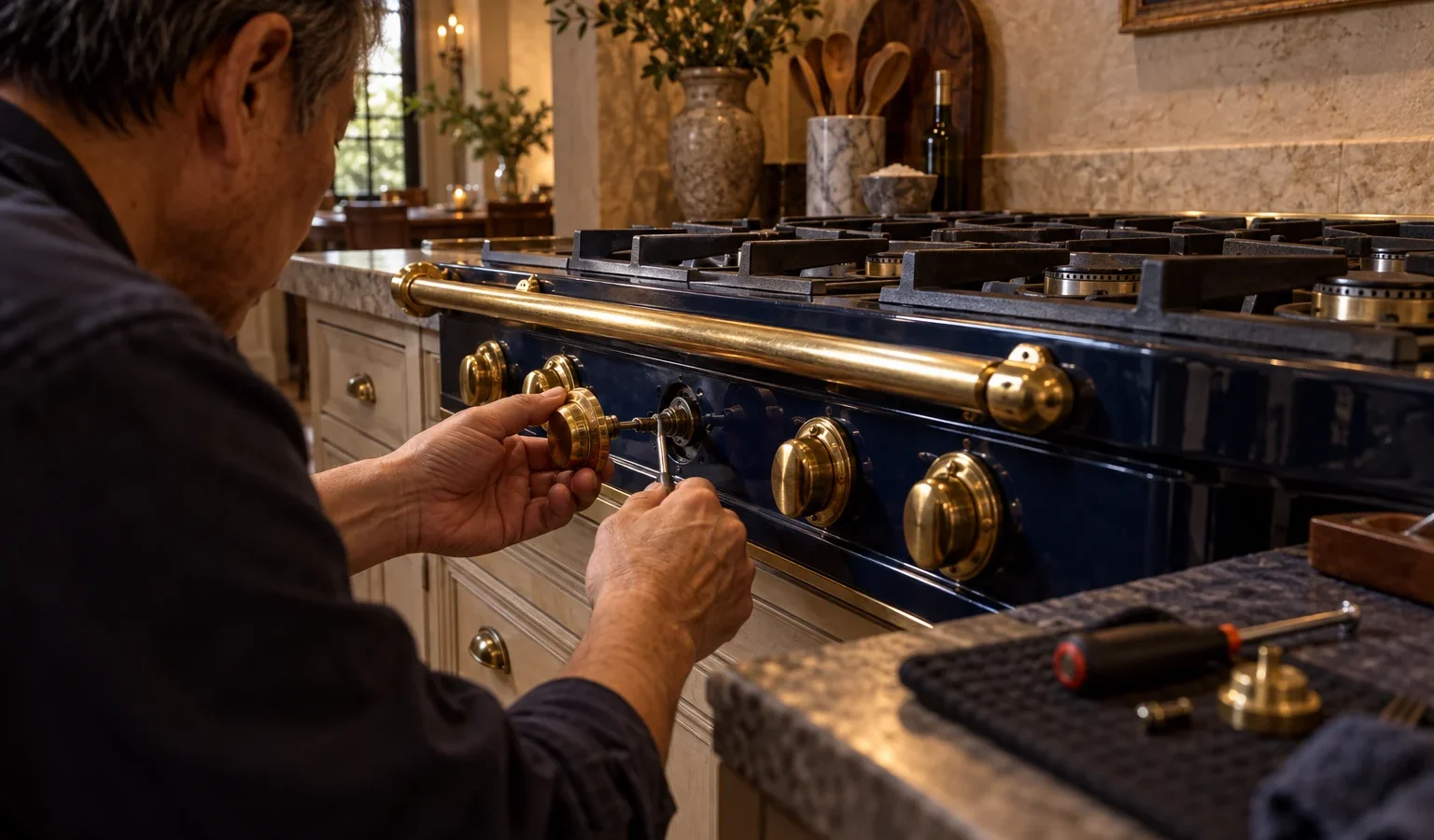
On a La Cornue rangetop, each knob is connected to a gas valve that meters the flame, and on many burners the same movement also triggers the spark. That connection is mechanical and precise, so when a knob feels different the cause is rarely the knob itself. Owners notice it first as a change in feel: a turn that grates, a knob that spins without much resistance, a flame that does not follow the position you set, or a burner that lights but will not stay lit.
This article sorts those symptoms into likely causes, shows the checks that are safe from the outside, and explains why valve work is a job for a technician with the right parts.
Turning the knob opens the valve against a spring and, at the start of the turn, closes a switch or presses a mechanism that sends spark to the burner. Gas then flows to the burner, the igniter fires, and a flame safety device confirms the flame. Lower on the dial, a smaller opening gives a low flame for simmering. Each stage depends on smooth movement inside the valve, so wear, residue or a loose connection at any point shows up as a change you can feel or see.
Stiffness often comes from residue inside the valve stem, such as dried grease or spilled liquid that worked its way past the knob skirt. Heat cycling over a long period can also dry out lubrication on the stem. Forcing a stiff knob can strip the connection or crack the valve, so stop pushing once you feel resistance. Never spray lubricant into the opening; it can reach places that must stay clean and dry around a gas component.
A knob that moves freely may simply have worked loose on its stem, or the internal fitting may have worn. If the knob lifts straight off with no drag at all, treat the control as unreliable until it has been looked at, because you can no longer be sure the position you see matches the opening of the valve.
If the flame is far higher or lower than the knob suggests, or the low setting goes out, the valve may not be metering correctly, or the burner may be getting an uneven supply. Compare it with a neighbouring burner. If only one burner misbehaves, suspect that valve. If several do, a supply or regulator problem becomes more likely. See La Cornue burner flame yellow or uneven for the flame side of the story.
A spark switch that stays engaged can keep clicking even when a flame is present. Moisture under a cap, or a knob that does not return fully, can do the same. The full explanation is in La Cornue burner clicking constantly.
That points to the flame safety circuit. If the safety device does not sense the flame, or if the valve does not hold open once the flame is proven, the burner shuts down by design. This is a safety behaviour, not a nuisance, and it should be diagnosed rather than bypassed.
Do not remove the control panel or the surround, do not loosen or tighten any gas fitting, and do not swap knobs between burners to test them. Do not use a burner whose valve will not turn off cleanly. If a knob will not return to the off position, close the gas shut-off valve to the range and stop using it. If you ever smell gas, leave the house, avoid switches, and call the gas utility or 911 from outside. A burning smell or sparks near the controls means power off at the breaker.
Many San Francisco and Marin kitchens have gas lines that were extended during remodels, and wine-country estates often run on propane or on a converted supply. A valve and orifice combination that suits one supply is wrong for another, so the technician needs to know which fuel and which conversion your rangetop is running. Hand over the model and serial plate details and tell us what the house supply is.
When a knob or valve is the suspect, book a visit through La Cornue rangetop repair. A technician diagnoses before any repair, gives you a written estimate, and does nothing without your approval. The lineup in La Cornue rangetops includes widths from compact to very large, such as the Château 90 cooktop and the Château 120 cooktop, and parts are matched to the exact model. If the issue is a surface that heats unevenly rather than a control that feels wrong, read La Cornue simmer plate and French top.
The knob is tied to a gas valve and often a spark switch. A change in feel usually means residue, wear or a loose fitting in that assembly rather than a fault in the knob itself.
Not if you cannot confirm that the setting matches the valve opening. If the knob turns with no resistance or will not return to off, shut the gas valve to the range and book a visit.
No. Spray lubricants can reach parts that must stay clean and dry near a gas component. Stop turning it and have the valve examined.
The flame safety circuit is not proving the flame, or the valve is not staying open. The burner shuts down on purpose, and it needs diagnosis rather than a workaround.
Yes. Valves and orifices are matched to the fuel, so the technician needs to know which supply your home uses and whether the rangetop was converted.
Share a few details and we’ll confirm an appointment. Prefer to talk? Call us and we’ll help right away.