

Specialized La Cornue Appliance Repair in San Francisco
Mon–Sat: 8:00 AM – 7:00 PM
A solid simmer plate or French-style top heats differently from open burners. Here is what uneven heat, slow warm-up and stubborn marks usually mean on a La Cornue rangetop.
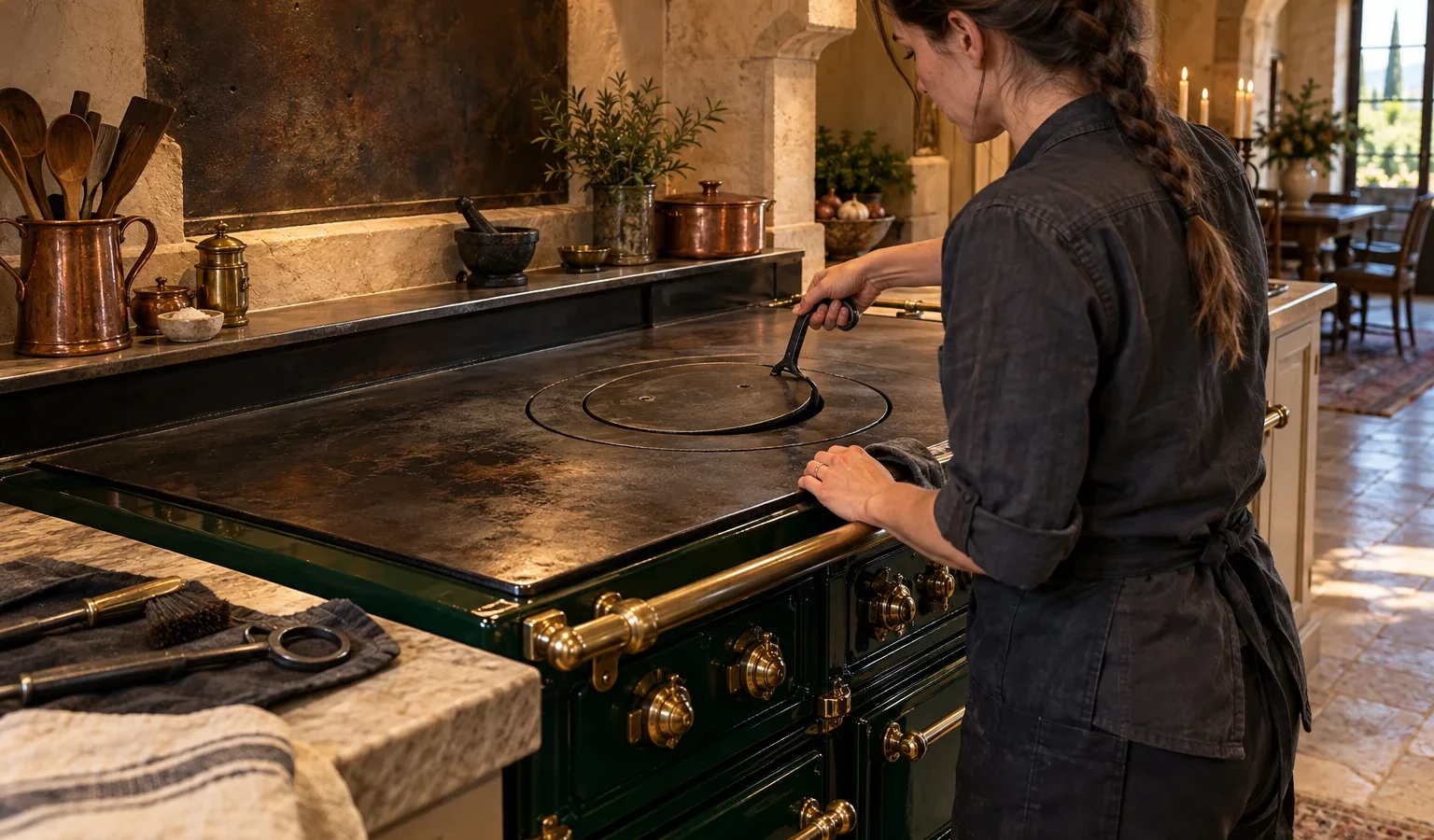
Many owners choose a La Cornue rangetop for the way a solid, heavy cooking surface holds and spreads heat. If your rangetop has a simmer plate or a French-style top, it is working on a different principle from the open burners beside it: a burner sits underneath and warms a thick surface, and the pan draws from that surface rather than from a flame. When something is off, the symptoms are quieter than a burner that will not light. Heat arrives late, one side runs cooler, or the whole surface seems tired.
Below is how to tell normal behaviour from a fault, what technicians usually find, and which checks are safe for you to make from the outside. Details differ between configurations, so treat this as a general guide and keep your model and serial plate details handy.
A heavy plate is slow by design. It takes a while to come up to working temperature, it stays hot after the control is turned down, and it develops a darker, mottled finish with use. Colour shifts, faint rings and a patina that builds over time are part of how these surfaces age and are not a sign of damage. What is not normal is a change from your own baseline: a plate that used to be ready in a familiar time and now lags, a cool band down one edge, or a surface that heats only after repeated attempts to light the burner below.
Keep a note of how your plate behaved when everything was right. A technician can reason much faster from “it used to be even across the left half” than from “it feels weak”.
Because heat travels outward from the burner underneath, a cool area often points to the flame pattern below rather than to the plate itself. A partly blocked burner port, a flame that has drifted from its original shape, or a plate that no longer sits exactly as it was installed can all push heat in one direction. Spilled liquid that boiled away and left residue on the underside of a pan will not cause this, but a build-up of residue on the surface can mask the real heat.
Slow warm-up is commonly a gas supply or flame quality issue: a low flame, a valve that is not opening fully, or a regulator that is not delivering steadily. In older Bay Area homes with retrofitted gas runs, a long or undersized line to a heavy rangetop can make this more noticeable when other gas appliances run at the same time. A technician checks flame appearance, valve movement and supply behaviour together, because fixing one without the others tends to bring the symptom back.
This is the same family of problem as any burner that clicks and does not catch: a dirty or damp igniter, a spark that is weak or wandering, a burner head that is not seated, or a flame safety component that is not proving the flame. Our guide to La Cornue burner won’t light walks through the logic, and the clicking behaviour is covered in La Cornue burner clicking constantly.
Cleaners that were not made for the finish, abrasive pads and acidic spills left to sit can mark a cooking surface permanently. If a mark does not wipe away with a soft cloth and warm water, stop there. Escalating to stronger products usually makes the surface worse and can leave residue that smokes on the next firing.
A light smell after cleaning is usually residue burning off. A sharp, persistent or chemical smell is different, and so is any smell of gas. If you smell gas, leave the kitchen, do not touch switches, and call the gas utility or 911 from outside.
Work only from the outside, with everything cool.
Do not remove the plate or surrounding panels to look underneath, do not reach for gas fittings, and do not run a lit burner with the plate out of position. Do not try to compensate for a cool zone by leaving a control on high for a long stretch; it hides the real fault and puts extra stress on the surface and the burner beneath. Avoid scouring a finish to remove marks, and avoid pouring cleaner onto a warm top.
Book when a cool area keeps returning, when warm-up has clearly changed from what you are used to, when the burner under the plate lights only on some attempts, or when the knob feels loose or stiff. A visit begins with diagnosis before any repair, you receive a written estimate, and nothing is repaired without your approval. Our La Cornue rangetop repair page explains how the visit runs for Bay Area homes, from Pacific Heights townhouses to Napa and Sonoma kitchens where the rangetop sits in a custom island.
Because parts are specific to the model, having the full plate details ready matters. Sizes in the lineup run from compact to very wide, including the Château 75 cooktop and the Château 150 cooktop, and a plate on a wide unit can behave differently from one on a narrow unit. For the whole lineup, see La Cornue rangetops. If the knobs themselves feel wrong, La Cornue rangetop knobs and valves covers that side.
Usually not. A solid cooking surface changes colour and develops a mottled patina with use. A defect shows up as a change in how it heats, not in how it looks.
Heavy surfaces are slow by design, but a clear change from your normal warm-up often points to flame quality, a valve that is not opening fully or an uneven gas supply. A technician checks these together.
It is better not to. Harsh products and abrasive pads can mark the finish for good and leave residue that smokes when heated. A soft cloth and warm water on a cool surface is the safe limit.
Yes. The plate depends entirely on the burner under it, so igniter, flame and valve checks are part of any simmer plate diagnosis.
The model and serial plate details, which area of the plate is cool, how long warm-up takes compared with before, and anything you already checked.
Share a few details and we’ll confirm an appointment. Prefer to talk? Call us and we’ll help right away.