

Specialized La Cornue Appliance Repair in San Francisco
Mon–Sat: 8:00 AM – 7:00 PM
A gas smell near a La Cornue range is a safety matter before it is a repair matter. Learn the immediate steps, the harmless odours, and what a technician checks afterwards.
If you smell gas now, do not read further inside the house. Leave the kitchen and the building, avoid light switches, appliances and anything that could spark, and call the gas utility or 911 from outside. Do not go back in until you have been told it is safe. The rest of this article is for afterwards, once the supply has been dealt with and you want to understand what happened.
Natural gas and propane carry an added odorant that is sharp and unmistakable, often compared to rotten eggs or sulphur. Several other smells get mistaken for it. A warm, dusty scent the first time the oven runs after a long break is usually residue burning off. A sharp, slightly metallic smell after cleaning may be cleaner on a hot surface. A brief whiff right after a burner lights can be a little unburned gas dissipating. The rule is simple: if you are unsure, treat it as gas, because being wrong about a harmless smell takes up a few minutes, while being wrong about gas can be serious.
A knob nudged by a pan handle or a child can release gas with no flame to burn it. Modern flame safety devices are designed to prevent this, but an older or worn device may not hold as it should. If a burner runs without a flame, the safety system needs checking, not only the knob.
If the igniter is dirty, damp or weak, gas can flow for a moment before the flame catches and then ignite with a small pop. Repeated delayed lighting is a diagnostic sign. The checks for lighting faults are in La Cornue burner won’t light.
A gas oven that tries to light, fails, and keeps feeding gas may smell strongly when you open the door. Ignition or flame sensing in the oven cavity is the usual suspect, and the oven should be left off until it has been examined. The related symptom is covered in La Cornue oven not heating.
Gas joints can loosen over time, especially on a heavy range that has been moved for cleaning or flooring work, or in a home where the flexible connector was fitted during an old remodel. A leak at a fitting is not something to test with a flame. Technicians use proper detection methods and the right fittings for the supply.
Some hillside and wine-country properties run on propane, and some ranges have been converted from one fuel to another. A mismatch between orifices, regulator and fuel can cause unburned gas, yellow flames and odours. Ask whoever installed the range about the conversion history.
Do not search for a leak with a flame. Do not tighten or loosen fittings yourself, do not use soap solutions as a substitute for professional leak detection, and do not switch the range back on to see whether the smell returns. Do not open range panels. If you smell burning or see sparks, switch off at the breaker as well, but only if you can do that without delay and without passing through the gas smell.
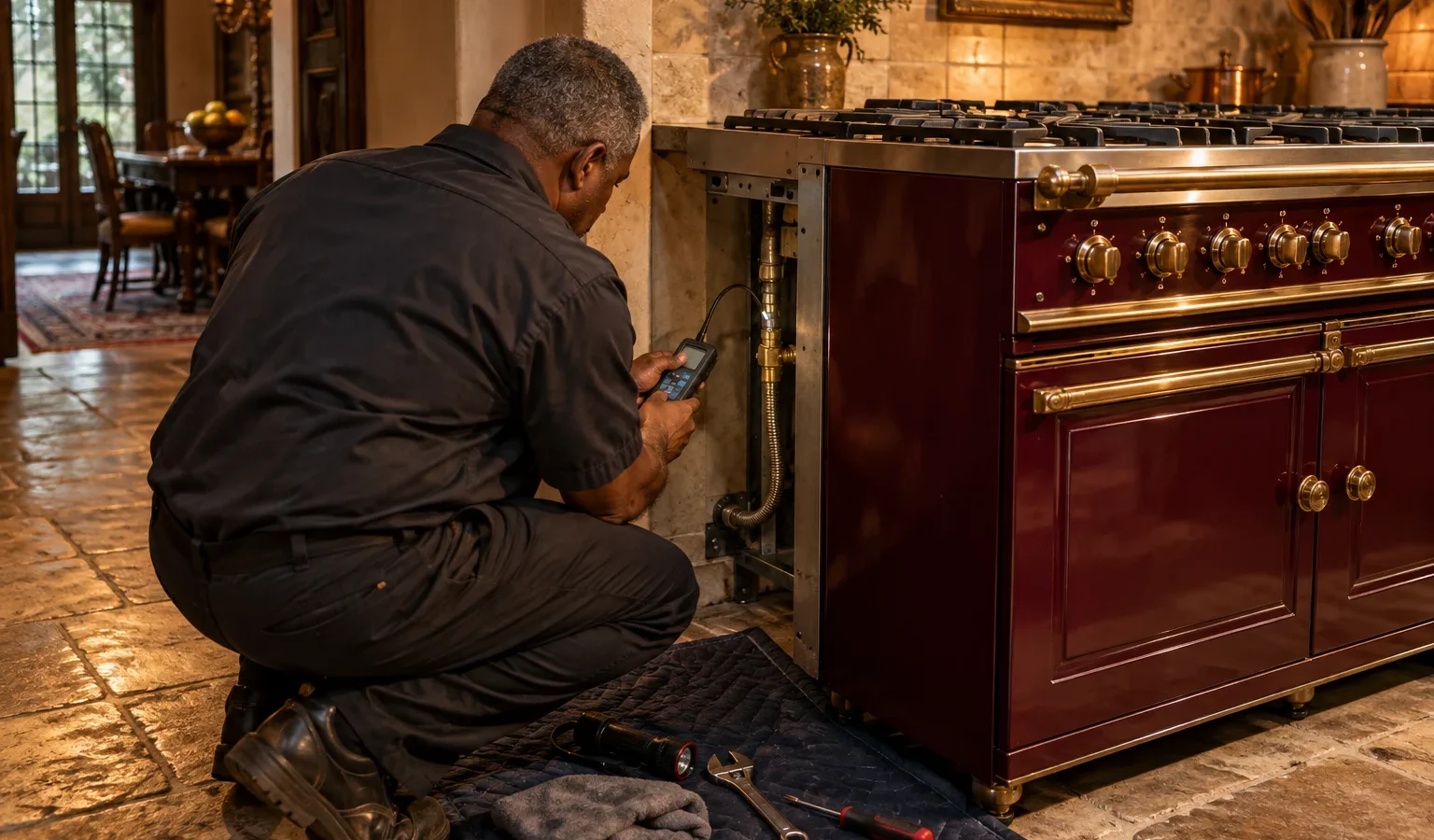
Once the supply is cleared, a technician should inspect the range before regular use. A visit begins with diagnosis, you get a written estimate, and nothing is repaired without your approval. The technician will usually check the shut-off valve, the connector and joints, burner valves, igniters and flame safety devices, and the oven ignition system. The full scope is on La Cornue range repair.
The model and serial plate is usually behind a lower door or drawer, or on the frame behind the oven door. Photograph it before the visit. It matters because fittings, orifices and safety components are matched to the exact range, including whether it was set up for natural gas or propane.
Keep burner caps and heads seated and dry, so burners light cleanly. Wipe spills before they dry onto igniters. Know where the shut-off valve is, and make sure everyone in the household, including house managers and cleaners, can find it. If the range was installed years ago and never inspected, see La Cornue range installation checks for what is worth confirming. For the broader family of ranges, from the CornuFé 90 to the larger Château sizes, see La Cornue ranges.
When you book, say where the smell was strongest, whether a burner or the oven was in use, and whether the range has ever been moved or converted.
Leave the building, avoid switches and flames, and call the gas utility or 911 from outside. Do not go back in until you are told it is safe.
Only if you can do it instantly. Closing the gas shut-off valve to the range is the safer step if it is within easy reach, but never delay leaving the house.
Yes. An oven that fails to ignite can keep releasing gas, which you notice when you open the door. Leave the oven off until it has been examined.
A little unburned gas can reach you before the flame catches, especially with a dirty or damp igniter. Frequent delays or a strong smell are worth a diagnosis.
Wait until the utility has confirmed the supply is safe and the range has been inspected. A smell that disappears has not necessarily been fixed.
Share a few details and we’ll confirm an appointment. Prefer to talk? Call us and we’ll help right away.