

Specialized La Cornue Appliance Repair in San Francisco
Mon–Sat: 8:00 AM – 7:00 PM
Many range faults begin on installation day. This checklist covers the gas, electrical, level, clearance and hood details worth confirming on a La Cornue range.
A La Cornue range is often the centrepiece of a kitchen that was designed around it, and the quality of the installation decides how well it performs. Many symptoms that arrive as service calls, such as weak flames, slow ovens, uneven heat, tripped breakers or odd noises, trace back to something about the way the range was connected or positioned. This article lists what is worth confirming, whether you are commissioning a new range, moving into a house that already has one, or investigating a problem that never quite went away.
Installation work itself belongs with qualified trades. What follows helps you ask the right questions and notice what is off, and what to tell a technician when you book.
Gas ranges need the right pressure and the right flow. A line that was adequate for a lighter range may be too small for a heavy range with several burners and a large oven, particularly in older San Francisco houses where the gas run was extended piece by piece. Weak flames that improve when other gas appliances are off are a typical clue. The regulator must match the fuel, and the shut-off valve should be accessible without moving the range. Confirm whether the range is running on natural gas or propane, and whether it has been converted; the burners and valves are set up differently for each. The flame appearance can reveal a mismatch, as described in La Cornue burner flame yellow or uneven.
Even a gas range needs electrical power for ignition, controls, lights and fans. Dual fuel and electric oven configurations need a dedicated circuit sized for the load, and induction models draw significantly more. A shared or undersized circuit shows up as intermittent faults and breakers that trip when the oven and cooktop run together. Check that the outlet or junction is correct for the configuration, that the supply is grounded, and that the breaker is labelled so the household can find it. The dual fuel side is covered further in La Cornue dual fuel range issues.
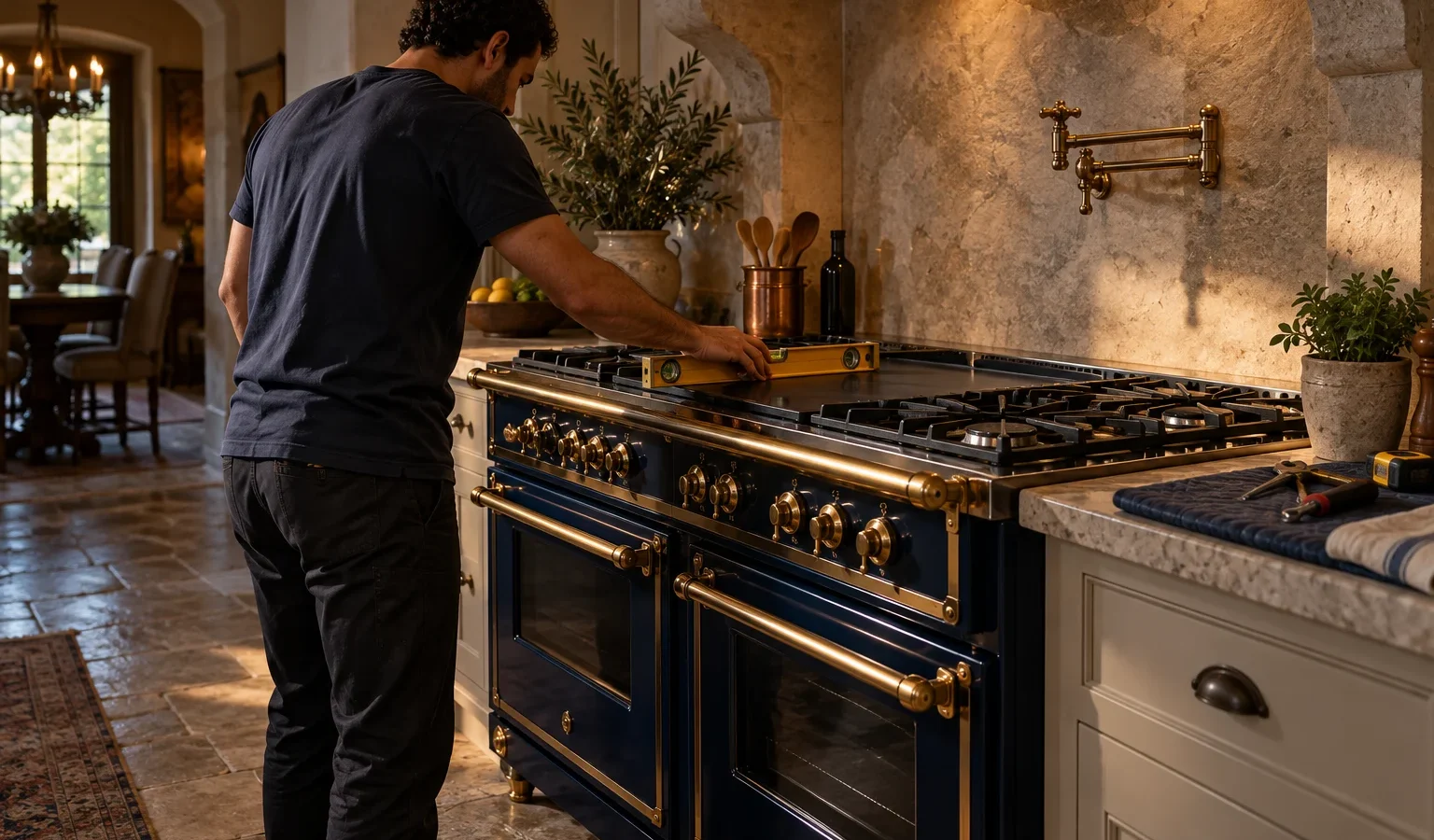
These ranges are heavy and are commonly installed on a custom base or between cabinetry. If the floor is not level, the range may rock, the oven may heat unevenly, and liquids in pans pool to one side. Hillside houses and older buildings sometimes settle, so a range that was level at installation may not be level now. Make sure the base supports the full weight and that the range does not move when you lean on it. Moving the range to clean behind it is a common way for gas connectors to get strained, so do it only with a trade who can reconnect and test.
Allow the clearances that the installation requirements for your model call for at the sides, back and above. Heat-sensitive surrounds, tight cabinet fits and decorative panels near the range can discolour, warp or trap heat. A range set flush between cabinets still needs room for the oven vent and for access to the shut-off valve and electrical connection. When a remodel changed the surroundings after the range was placed, recheck them.
A powerful range wants a matching hood. The duct run should be as short and straight as the building allows, with a termination that is not blocked, and the room needs make-up air so the hood is not fighting a sealed house. Many modern Bay Area homes are tight, and a hood that seems weak is sometimes starved for air rather than faulty. The hood also needs its own power supply and controls working correctly. If the hood is the issue, see La Cornue hood noisy or weak.
With the range in position, open and close the oven door. It should close squarely with an even gasket seal, and the door should not catch on adjacent cabinetry. Heat escaping around a door is both a performance and a safety concern; see La Cornue oven door and gasket problems.
If the range has symptoms that suggest an installation cause, such as weak flames on a long gas run, a breaker that trips, or an oven that will not hold an even level, book a visit through La Cornue range repair. A technician diagnoses before any repair, provides a written estimate, and does nothing without your approval. For the sizes in the lineup, from the Château 120 range to the Château 165 range, see La Cornue ranges. And if gas has been smelled, read La Cornue range smells of gas first.
Ask who connected the gas and power, which fuel the range was set up for, and whether the connection was tested. Keep those answers with the model plate details.
Qualified trades should do the connection and test it. As owner, your role is to confirm the supply details and keep the shut-off valve and breaker accessible.
A gas line that is too small or too long for the load can starve a heavy range. A technician checks supply behaviour alongside the burners and regulator.
Often. A long or blocked duct run, or a lack of make-up air in a tight house, can make a good hood seem weak.
Better not to. The weight can strain the gas connector and electrical connection. Have a trade move it, reconnect it and test it.
Photograph the model and serial plate, note the fuel type and any conversion, and record where the shut-off valve and breaker are.
Share a few details and we’ll confirm an appointment. Prefer to talk? Call us and we’ll help right away.